

News: A New Study Reveals Breakthrough in Barley Genetics.
Updated: Jan 22
Published 8AM EST, Fri Jan 16, 2026 The researchers show how the MKK3 gene complex regulates seed dormancy and sprouting in cereals — insights that could open new breeding strategies for crops that withstand climate extremes while meeting a range of agricultural needs.
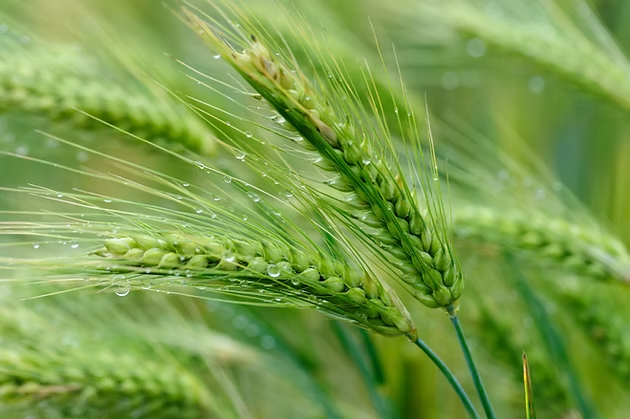
Pre-harvest sprouting (PHS) represents one of agriculture's most costly challenges, causing billions of dollars in global losses annually. This phenomenon occurs when mature grains germinate prematurely on the plant, typically triggered by warm, humid conditions before harvest. Once seeds sprout, they fail to meet quality standards required for brewing, distilling, and animal feed industries. A multinational research team led by Carlsberg Research Laboratory, with scientists from The James Hutton Institute, has now identified the genetic mechanisms behind this critical issue. Published in Science, the research reveals how the MKK3 gene complex regulates the delicate balance between seed dormancy and germination in cereals. According to Dr. Joanne Russell, different MKK3 variants have been selected over thousands of years by farmers seeking to balance dormancy (preventing premature sprouting) against the rapid, uniform germination required by malting and brewing industries. The wrong combination of these variants can prove disastrous in certain growing environments, making this understanding critical as climate change exposes more regions to PHS risk. The findings extend beyond barley to other major cereals including wheat and rice, positioning this research as foundational for global food security. Supported by £62 million through the Tay Cities Region Deal, the International Barley Hub aims to translate such discoveries into breeding solutions that help crops withstand climate extremes. The research community anticipates these insights will accelerate development of resilient crop varieties worldwide. Like cereals, cannabis cultivators face the challenge of managing seed dormancy — seeds must remain viable during storage and transport yet germinate reliably and uniformly when planted. Understanding the genetic architecture controlling dormancy versus germination timing could inform cannabis breeding strategies, particularly for commercial seed operations managing germination rate consistency across varieties. Additionally, as cannabis cultivation expands into diverse climates, identifying analogous dormancy-regulating genes in Cannabis sativa could help breeders develop varieties resilient to humidity fluctuations that trigger premature germination or, conversely, excessive dormancy that reduces germination rates. For operations conducting germination testing and quality control, this research underscores the genetic complexity underlying seed viability metrics and suggests opportunities for marker-assisted selection in cannabis breeding programs.
Source: SeedWorld